Learn the beginning steps of hand-knitting in the video below!
Enjoy!

Showing posts with label Craft. Show all posts
Showing posts with label Craft. Show all posts
Monday, December 10, 2012

Monday, December 3, 2012
Notable Hands - Craft - Dyeing Fabrics
 |
| Rodarte Fall 2008 |
Let's talk about dyeing fabrics at home.
This is also one of the essential tools in textile design,
and one that designer usually opt for when they’re looking for specific shades
in their own collections - ones that are not available from fabrics manufacturers.
Rodarte, the brand created by sisters Laura and Kate
Mulleavy, works with a specialized fabric-dyer to get a unique shade for their
collections. For instance, once they spent months looking of the perfect
red-cock shade. This means that they use a lot of time, and resources for the
coloring of their collections. That’s how important color is.
You can practice fabric dyeing at home too - either with
natural, or synthetic colorants. Say you want a shirt to look ivory instead of
crisp white; you can just dip it into a black tea pot for a few minutes/seconds
until you see the perfect shade. Remember, after the fabric dries out, the
fabrics looks lighter.
But when you are using strong colorants, it is always useful
to try the exact shade you want with a small piece of the same fabric you’re
using beforehand, and after you got it, you can actually dye the real fabric.
Some fibers are easier to dye. With synthetic materials, you
might not even be able to change their shade, but wool, silk, cotton and linen
are the best and friendlier materials to dye at home.
 |
| Dosa |
 |
| Artisan dyeing fabric with indigo |
 |
| DIY dyeing at home |
Try it out, you’ll be surprised at how easy it is.
Notable Hands - Craft - Embroidery

Let's talk about embroidery.
Beading and embroidery are techniques that usually get confused. Embroidery is the art if decorating fabrics and different materials with a needle and thread, or yarn - while Beading is the technique of sewing beads and sequins into fabrics.
Embroidery is a very exciting technique, because while someone can think embroidered fabrics look outdates, many luxury labels also used them to add textures and pattern to their original materials.
Embroidery entails everything from chain stitch, buttonhole or blanket stitch, running stitch, satin stitch, cross-stitch, when it comes to handmade techniques. However, embroidery can also be done by machine, but these pieces are less original and cliché examples.
Artisanal embroidery looks very unique, but once you know the basic technique, you can basically embroider paper, and furniture materials.
 |
| Chanel |
 |
| Missoni |
 |
| Maiyet - sold at Barney's |
Monday, November 26, 2012
Textile Design & Silk Screening

Humans have been dying fabric ever since times started. It
is no secret that there are countless of techniques, industrial and DIY
involved in the process of putting color and prints into woven surfaces. Some
of the most artisanal techniques are Batik, which is based on wax to create
patters, the most well known tie-dye, woodblock printing, which is an Indian
specialized technique, and one of the most common, yet sophisticated techniques
– silk screening.
This technique can be practiced at home, at the same time
that the most high-end labels also use it to print unique motives into their
fabrics. A silk Hermès scarf can be silk screened with more than 40 different
patterns – one for each color – at the same time that someone at home can make
a cool t-shirt or a canvas tote out of one and only screen. The possibilities
are endless, and the process is pretty much 100% manual.
In order to work with silk screens, the specialized textiles
designer or artisan uses a woven mesh that acts as a blocking stencil. The
fabric has to be placed on a flat surface. After the screen in located in the
right place on top of the fabric, ink is poured horizontally on the screen, and
a blade is then slid across the length of the screen, and back. This enables the
ink to flow uniformly within the mesh pattern on the screen, and no residues
are left behind. Only the open mesh areas can transfer ink into the materials,
and it’s possible to see the result instantaneously.
Also, any kind of flat surface can be printed, starting with
natural fiber fabrics to canvases, and even knits.
 |
| Erica Tanov's totes being silk-screened |
Take a look from the Hermès demonstrations in San Francisco,
and Erica Tanov’s unique tote designs and production.

 |
| Final Tote |

 |
| Hermès printing demonstration |
Monday, November 5, 2012
Erica Tanov Collaborates With Paper Artist Emily Payne
It's hard not to fall in love with the seamless collaboration between fashion designer Erica Tanov (feature coming soon!) and artist, and paper specialist Emily Payne.
That's when craft enables you to turn simple objects into wonderful, dreamy pieces.
See for yourself!
Erica Tanov / Emily Payne from Emily Payne on Vimeo.
Satya Twena Creates Lush Hats!

If the art of dressing up our own bodies is a matter of countless conversations, then imagine the fuss that comes with wearing objects on top of our heads. We are here to talk about some headpieces that have actual heads turning around in the streets – Satya Twena collection of women’s hats.
Satya Twena is not the kind of designer that used to create paper and flower hats ever since she was a kid. She is the kind of creative persona that only after growing up discovered a way of expressing her creative anxiety through design. (Actually, some of the most interesting designers we know didn’t know that they would turn out finding their true passion in fashion and accessories design). This former interior designer was never a stranger to the art world, but she discovered her love of designing hats by chance, taking an evening class at FIT in millinery in 2009.
 |
| Pooka Hat |
 |
| Satya Twena New Campaign |

Shortly afterwards Twena’s mother was diagnosed with breast cancer, which resulted in the initiation of her now lauded millinery career, as well as the realization that she wanted to live every day to the fullest. What started as a hobby turned out to be a way of expressing her own creative self, as told by the designer in an e-mail interview we conducted last month. “I just had all these energy and didn’t know how to release it… it just ended up being creating energy.” (see Jacob’s Creek True Character Series).
Twena business grew rapidly from making hats and caps for her mother, to receiving orders from friends, family, and word of mouth clients. Twena is one of the fewcouture milliners based in New York City. She sells to a range of upscale boutiques and department stores, and also enables customers to shop from her own e-commerce site and have costum hats made personally! Talk about small luxuries.
In ST’s collection there is a hat for every kind of woman – and a range that goes from casual to black-tie occasions, with new takes on felt fedoras, floppy wide brim chapeaus, 20s-inspired cloches, and equestrian riding hats. The designer describes her line as “feminine with a hint of vintage and a dash of sexiness,” which is a product of her use of deep jewel tones, high quality materials and sweet elements, such as pearl pins, and a flower or ribbon here and there.
 |
| Satya Twen wearing her own design |
Through her craft, not only has Twena found who she is, but she has also strived to reflect her client’s personality through her designs. “What differentiates me and my work is my ability to see past the physical and tap into my client’s character and desires to create wearable art.”
Twena’s newest endeavor is ST’s sister company Discover Pique, a hosiery line that acts as a “monthly curated hosiery subscription.” Sounds like the perfect compliment to the ST woman. Just take feminine classics like a back seam, fine dots, and lacy tights, and top any getup with one of her lush hats!
Jacobs Creek Presents True Character Series – Satya Tweena from Soap Creative on Vimeo.
Images Courtesy of Satya Twena
Monday, October 8, 2012
More videos of Hermès - Festival des Métiers
I hope you've enjoyed the videos on the Hermès Festival last month in San Francisco.
Here is another video of some of the other crafts presented within the same tent!
Enjoy!
Here is another video of some of the other crafts presented within the same tent!
Enjoy!
Monday, October 1, 2012
Has Visual Merchandising turned into an Art Form? We say yes!
San Francisco might not be the most fashionable city, but once in a while it amazes us with a the creative input up-and coming designers, boutiques, and the work of artists turned designers, or installation artists turned visual merchandisers.
Kavin Orantes, the new Visual Director at high-end retailer Wilkes Bashford might not have planned to develop a career in fashion. But as shown in his windows bellow, he might have just found the place to express his love for clothes and creativity.
We had a little chat with him about the craft of directing the visuals at Wilkes.
 |
| Pre-fall windows at Wilkes Bashford |
What does your work at Wilkes Bashford entail?
My work is mainly consists in the visual display of all the brands at Wilkes, starting with the window displays – from sketch to actually putting on the windows. I also do merchandising, and sometimes a little bit of administrative work, collecting records for the store’s buyers.
With your background in fine arts, how has this helped you to create a visual identity for the store?
My background in fine arts has helped me in terms of understanding color, and how to compose window displays. So, the windows are created as I would create a painting – starting with the rhythm, the composition, colors, the space, and the unity of it all. My goal is to bring it out, and push it forward into a more artistic view of windows, and not just have clothing displayed in plain air. I can create a story, and actually enhance the look of the clothes.
Also, inside the store I oversee the styling of the mannequins and forms, the color story of absolutely everything. The merchandising for me is more based on color, and that way I can have a synchrony in each floor. The point is to make it look beautiful, and then organize it, so that the customers feel attracted to the clothes.
Tell me about these two windows that you created recently.
The first window is called “From the Sketch.” It was a sales window. The whole point was to put sketches of the garments that we carry at the store. First it was just sketches of garments. And to be honest, at that part I was just playing, an planning to do a huge collage with clothes on the window. But when I was actually putting it all together I came up with the idea that it would be better to put “paper clothing” on the forms. So I created some dresses, sports jackets and shirts with the sketches I had done.
 |
| From the sketch |
 |
| Sales window |
The second window has a traveling them and it’s called “And away we go.” The backdrop is made of vintage postcards from different parts of the world – these had been collected over the years by Wilkes’ manager of both stores. To portray this story we used one of our biggest brands, Brunello Cuccinelli. Their garments are really versatile, and you can actually wear them on different occasions, everywhere in the world. They not only matched the idea of travel, the brand look is trimmed and young, and their color scheme and fabrics give a great example of luxury travel garments. I was trying to make it look cool with airplanes, cutting the window in spaces, and thus, framing the different looks on the window.
 |
| And Away we go! |
How has your craft, and the different techniques that you’ve learned along the years helped you accomplish this kind of creative work?
I have the vision of an artist, but I need it to fit with the vision of a visual merchandiser. Now I’m using them both together, in order to deliver a better visual display.
How long does it take you to crate the windows?
The making of a window can take from one to two months, starting with an idea that has to be presented to the company’s visual manager to be accepted. Once they give you an ok, the project goes into pre-production, where we see what we need for the window, and how are we going to get it – for example, the manufacturing of especial items, the props, new lights, and so on. This process takes about two months, and we build it all on the same day.
What is interesting is that we already have the projects of every window since the beginning of the year. These are planned according to the schedule of trunk shows, special event, and visiting vendors.
I also pull clothes from the store to style the mannequins. These have to be approved by the managers before dressing up the windows.
What is the favorite thing about your job?
Everything, but I think the process of creating window displays is my favorite part, because it is here where I can be free to create and express myself as an artist.
Images by Kavin Orantes
Monday, September 24, 2012
Hermès Festival of Crafts

A luxury brand is nothing without its artisans.
Inside a big tent in the middle of Union Square
Park in San Francisco, in celebration of its 175th anniversary, the
house of Hermès hosted a free event for everyone interested in craft, fashion,
style, and heritage to have a hands on experience. For five days, the
horse-carriage brand, with its authentic orange color and 10-year wait lists on
the most coveted celebrity-named handbags is celebrating the best thing they
have – their métiers and craftsmen.


 |
| Leatherworker |
About nine stations for different Hermès products
took place, in which Lyon-based artisans worked side by side to an English translator,
and pretty much gave the audience a tutorial of what goes on behind the scene
of the charming boutiques we all drool over.

 |
| Tie marker |

The art of sewing, threading, polishing,
framing, beading, cutting, and printing are no joke to the house. Artisans
usually have to go though a 5 year apprentice period before they can actually
be hired by the house, and be the experts of crafts like gilding glasses, making
watches, and sewing silk ties by hand – a process that can take 20 minutes
after the printed tie has been cut.
 |
| Watch station |
 |
| Gilding |
Some of the most coveted stations were the one
from the Leatherworker Dominique Michaux, who was sewing a blue leather Jypsière bag (a process that takes 20
hours to complete, and only one artisan for each bag), a unisex product for huntsmen
and women on the go. But certainly the showstopper was the silk printing
station where one artisan printed 14 silkscreens over the 90cmx90cm silk scarf
square. The process lasted about 90 mins. Silk printer Kamel Hamadou took the
audience over the process of printing scarves, a craft that takes about 6 years
to learn, and more time when it comes to fabrics like chashmere. Hamadou’s
French charm gave him enough patience to respond all kinds of questions from newcomer
visitors, and talk about the creative process for scarves. In order to present
the customer with 10 new designs each season, the developing process lasts two
years from beginning to end, and evolves, designers, engravers, colorists,
communications between the Paris headquarters and Hermès New York workshop.
Classic scarves continue to be produced, and ordered each season by each
boutique’s buyers. They can produce Asian pastels and a Brazilian jungle
explosion for the same design.


 |
| Silk screen demonstation |

 |
| Scarves engraving |
Another popular station was Faustine Pancin’s
gem setting. Women can’t stay away from some diamond bling! The specialized gem
setter has the task to set diminute diamonds over the whole contour of the best
seller “Collier the chien” (dog-collar) bracelet. She used dentist tools and
her own saliva to catch tiny diamonds and set them on specific wholes – as
there are five different gem sizes –, before securing it with the same metallic
structure. Viewers got the chance to see her in action and look through the
microscope.


 |
| Gem Setting station |


 |
| Twin-set lining station |

Another insider tip, the brown, pink and orange
scarf required one silkscreen to print the Hermès name and the design’s one in
a specific tone of dark brown. Mr. Hamadou stressed on the fact that there are
no special orders at Hermès. Each scarf has a 10-color palette option. However,
no queen jubilee, or any special celebrity can order an exclusive print for him
or herself. See, "when you buy Hermès, you don’t buy the signature, you
buy qualité," and its the same
for everyone.


Images by Laura Acosta
Sunday, September 23, 2012
Lots of Craftsmanship from New York Fashion Week
 |
| Proenza Schouler |
 |
| Alexander Wang |
Fashion week comes, and what happens in our heads? New trends, already seen trends, trends! We see color, and we see interesting shapes, part of new brand statements for strong, confident women.
Reviews won’t ever focus on the specific craft traits that particular hand-work-based
designers showcase, because that is not their focus. But it’s you readers who
might not know entirely the marvelous things that go through, and behind the
scenes, during the creation of the most coveted looks of the season.
I wouldn’t have started this blog if I didn’t think craft is one of the
motors that moves and differentiates different fashion houses from one another.
Craft, since is synonymous of quality, also relates the pieces to special
techniques, and heritage – if not of the house’s atelier, then specific
artisans and trade organizations around the world.
 |
| Proenza Schouler |
 |
| Proenza Schouler |
Proenza Schouler is off to great things this year – and let’s just say
that the opening of their Madison Ave flagship is no casualty. For SS 2013 they
are talking collages. They turned lather into a light fabric, or what people
may call leather-lace. Their patch-worked garments of leather were contrastingly
crocheted together by Madagascar artisans. Dresses of diagonal patches of bold solid
colors mixed with pop-culture photographs printed on fabric were a great
statement about the bombarding-information moment we are going though. Lazaro
Hernandez and Jack McCollough’s perfect balance of technology and handcrafts in
their collection is only a bit of proof of the modernity of their vision.
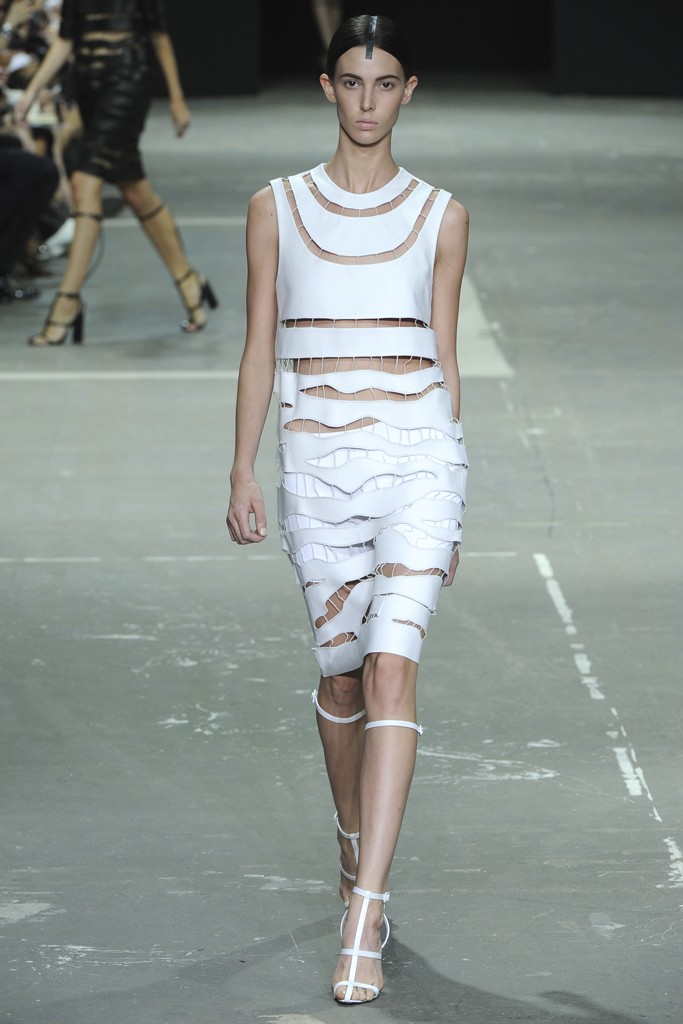
Another hip craftsman in New York is Alexander Wang. His collections are the epitome of cool in NYFW – alas the world. But he not only knows how to dress a tomboy girl sexily in black and white, he also makes it interesting to watch season through season. Wang presented dresses cut organically horizontally, which were later on put together with embroidery techniques that created a lace/pick-a-boo effect. “I wanted to start dissecting the pieces,” said the designer to WWD. “So we played with the idea of suspension and tension through embroidery techniques.”
 |
| Alexander Wang |
 |
| Alexander Wang |
Another hip craftsman in New York is Alexander Wang. His collections are the epitome of cool in NYFW – alas the world. But he not only knows how to dress a tomboy girl sexily in black and white, he also makes it interesting to watch season through season. Wang presented dresses cut organically horizontally, which were later on put together with embroidery techniques that created a lace/pick-a-boo effect. “I wanted to start dissecting the pieces,” said the designer to WWD. “So we played with the idea of suspension and tension through embroidery techniques.”
 |
| Rodarte |
 |
| Rodarte |
Now let’s talk about
Rodarte. The Muleavy sister duo has such an imagination, that me in my old
designing days who never ever be able to come close to. From their unique
world, this time, they brought a warrior princesses to the 21st
century. Garments had extreme angular cuts in contrasting fabrics, but the
designers also presented fairly straightforward pieces of hand woven jacquards,
and crocheted squares attached like chain mail in tops and skirts. Rodarte’s
ambition in knitwear design has put this technique in the highlight of fashion
with never before imagined possibilities in texture and shapes, and style.
We are left with the masters
of cut, Narciso Rodriquez and Francisco Costa for Calvin Klein.
 |
| Narciso Rodriquez |
Narciso Rodriquez is
not as hip as a designer, maybe because he certainly doesn’t dress all American
socialites on red carpet events, but his bias-cut dresses, and the
ultra-sophisticated color palette landed him on a prime spot as a notable
designer and craftsman. This spring collection added a little bit of extra
handwork with wooden laminated sequences in all sorts of nature tones – another
smart way of talking prints.
 |
| Calvin Klein |
 |
| Calvin Klein |
Calvin Klein Collection’s tailored shapes have the power of looking sooo Calvin Klein and minimalist, and yet so new and complex every season. This collection was primarily black, white and champagne, with structured bust shapes – think 21st century pinups. Dresses were then over-layered by organically woven wire cages that added liveliness to the overall look.
 |
| Donna Karan |
As far as Donna Karan,
we know she is and has been involved with artisans for a very long time. And
her collections reflect so. Dusty
sea colors made her SS 2013 palette of hand died, embellished dresses in linens
and silks as soft as sea foam. I cannot forget WWD’s quote basically implying
how passé feathers on dresses can look when shredded raffia has so much
lightness and charm.
Do you think craft can
be ultra-modern as well?
Images Courtesy of WWD
Subscribe to:
Posts (Atom)